
NOTE / PRACTICAL AI ADOPTION
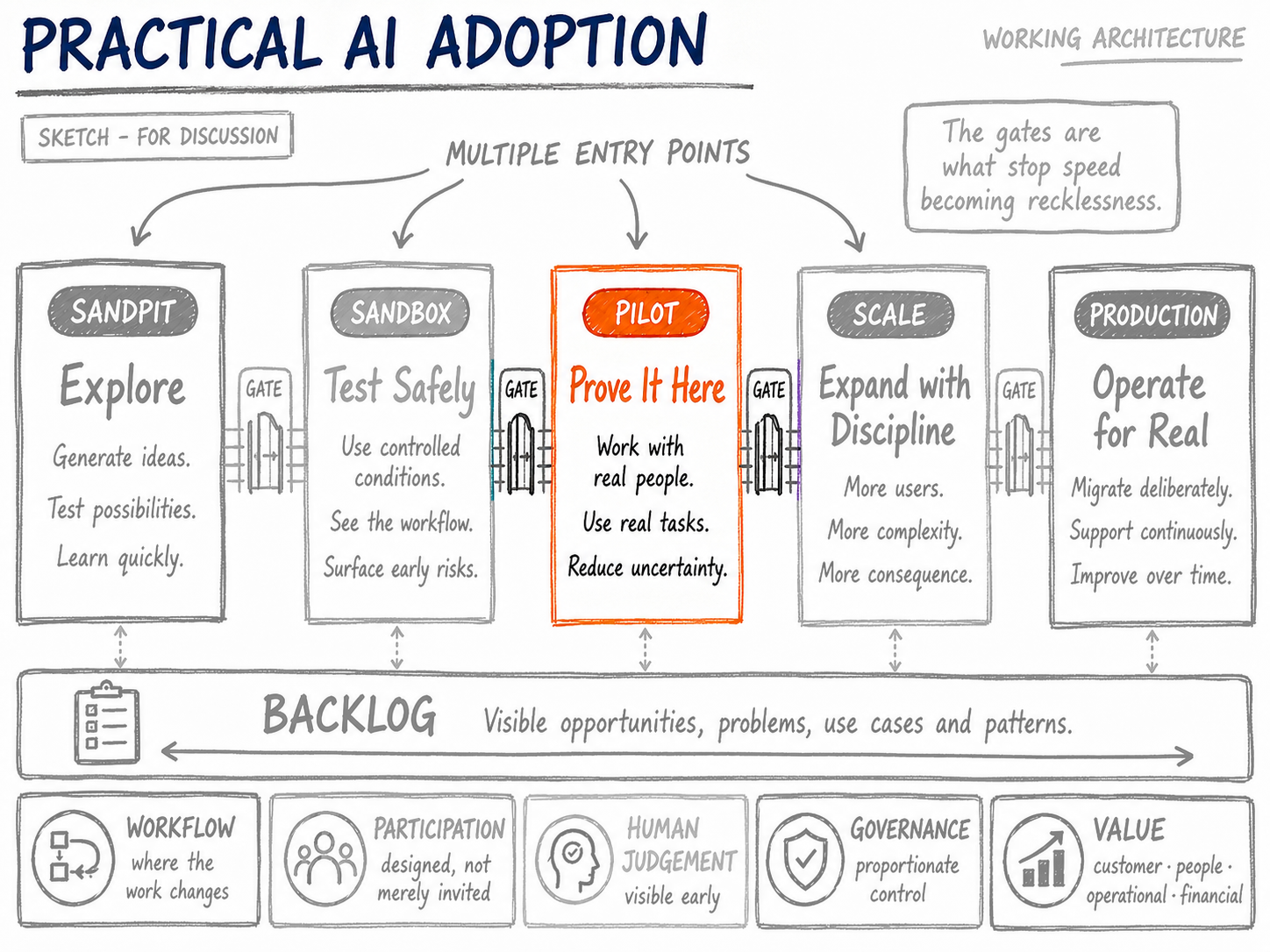
Pilot: Prove It Here or Don’t Call It a Pilot
A pilot should reduce uncertainty before a larger commitment is made.
“Let’s run a pilot.”
It sounds reassuringly practical.
But a pilot should do more than create activity. It should prove something here.
A useful pilot exists to reduce uncertainty before a larger commitment is made.
That means being clear about the question before the work begins.
What uncertainty is this pilot designed to remove?
For AI, that uncertainty may concern the technology.
But the harder questions are often about the business, not the technology.
Does it work inside the real workflow?
Can people use it effectively?
Where does human judgement need to remain?
What exceptions appear?
What controls are required?
Does the expected value actually materialise?
A pilot is therefore not simply a demonstration, a proof of concept, or a small rollout.
It should bring the idea into contact with real people, real tasks and real operating conditions, while keeping the scope deliberately bounded.
Sometimes the most valuable pilot is the one that proves an assumption wrong early.
And a pilot needs an ending.
At the gate, the organisation should be able to ask:
What did we learn?
What remains uncertain?
Do we stop, adapt, repeat or progress?
A pilot should not become a comfortable place where an organisation avoids making the next decision.
The point is not to prove that the technology can do something.
The point is to prove enough, here, to decide what should happen next.